Training Digital Innovation and Agile Governance in Tanzania
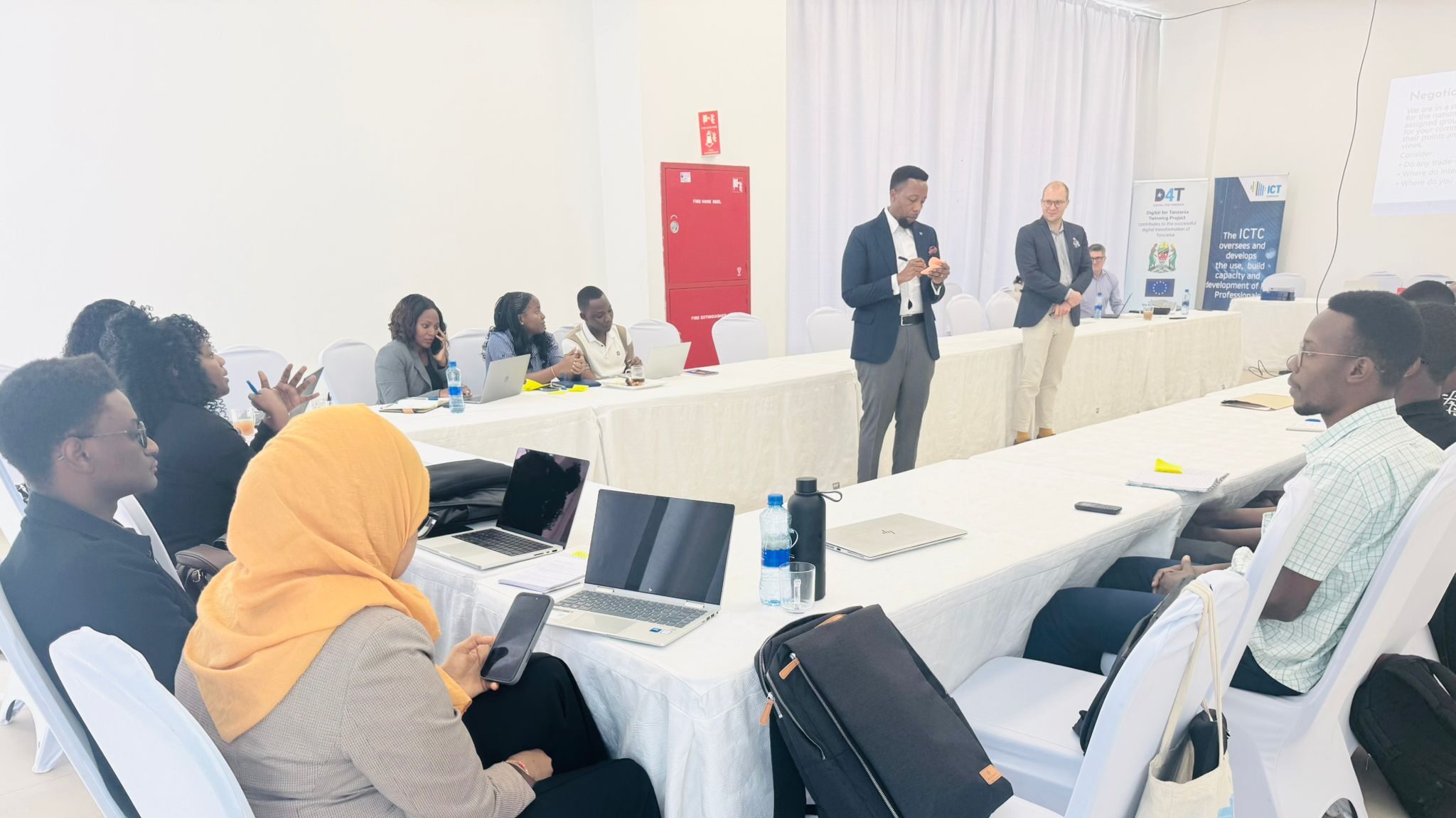
In late June 2026, HAUS Finnish Institute of Public Management delivered a five-day training on Digital Innovation and Agile Governance in Dar es Salaam, Tanzania. The training was part of the Digital for Tanzania (D4T) Twinning project and brought together Finnish experts and Tanzanian public and private sector professionals for a practical, hands-on learning week.
The training ran from 22 to 26 June 2026 in Dar es Salaam, designed for professionals and start-ups working on digital transformation and governance development in Tanzania.
From concepts to practice
The week opened with a shared foundation: what does innovation mean in a public sector context, and how does it differ from the private sector? Rather than assuming a common vocabulary, the training built one from the ground up — covering definitions of innovation, the role of public value creation, and institutional barriers that often slow down change in government settings.
From there, the programme moved into anticipation and strategic foresight. Participants worked through scenario planning and trend analysis, including a futures workshop built around the question: what could Tanzania look like in 2035? The aim was to build the kind of long-term thinking that complements — rather than conflicts with — the agile, iterative methods introduced later in the week.
Agile approaches to policy and service development formed a central thread throughout the training. Topics included user-centric service design, prototyping, and minimum viable policies — practical tools that both public administrators and start-ups can apply in their own institutions. The programme also addressed the real tensions in public sector agility: accountability requirements, compliance constraints, and the effect of election cycles on implementation.
Structures, ecosystems and procurement
Wednesday and Thursday focused on the Tanzanian context directly. Participants mapped and analysed the country’s existing innovation structures — from government agencies and universities to innovation hubs, civil society organisations, and development partners. The goal was not a theoretical overview but a working picture of where adaptive capacity already existed and where it could be strengthened.
Procurement received dedicated attention as a practical lever for innovation. The training explored outcome-based procurement, innovation partnerships, sandboxes and testbeds — and asked participants to consider alternatives to traditional procurement processes in their own institutional settings. A case study from Finland on institutional funders rounded out the day, followed by a workshop where
participants developed a concrete 90-day innovation challenge for their own organisation.
Closing with a path forward
The final morning included a facilitated session on developing practical working pathways for transformation. The week closed with a recap, feedback, and a photo session.
The training was delivered by a team of Finnish experts: Ms. Kristiina Lähde, Ms. Tiina Koivuniemi, Mr. Ilja Riekki, and Mr. Mika King.
Key Facts: Digital for Tanzania (D4T) Twinning Project
The Digital for Tanzania (D4T) Twinning project supports Tanzania’s digital transformation through e-Government reform and connectivity. Its specific focus areas are cybersecurity and data protection frameworks, interoperability and data governance, and private sector and research community capacity — including addressing the gender digital divide.
The project is led by HAUS Finnish Institute of Public Management, with junior partners the Estonian Centre for International Development (ESTDEV), and German federal ministries backed by GIZ. It is funded by the Delegation of the European Union to Tanzania and the East African Community, with the Ministry of Communication and Information Technology (MCIT) of Tanzania as the beneficiary. The project runs from July 2023 to December 2026, with a total budget of € 2M.