Learning by Doing: Inside the Digital4Tanzania Delegation’s Study Visit to Finland
By Dennis Karugaba, Resident Twinning Adviser Assistant (RTAA), Digital4Tanzania (D4T) Twinning Project
Between 21 and 25 September 2026, an eight-person delegation from Tanzania spent a week moving between startup campuses, research institutes, government agencies and a former hospital-turned-innovation-hub in Helsinki, trying to understand something that doesn’t fit neatly into a single meeting: how a country of 5.6 million people built a digital and innovation economy that punches well above its population size.
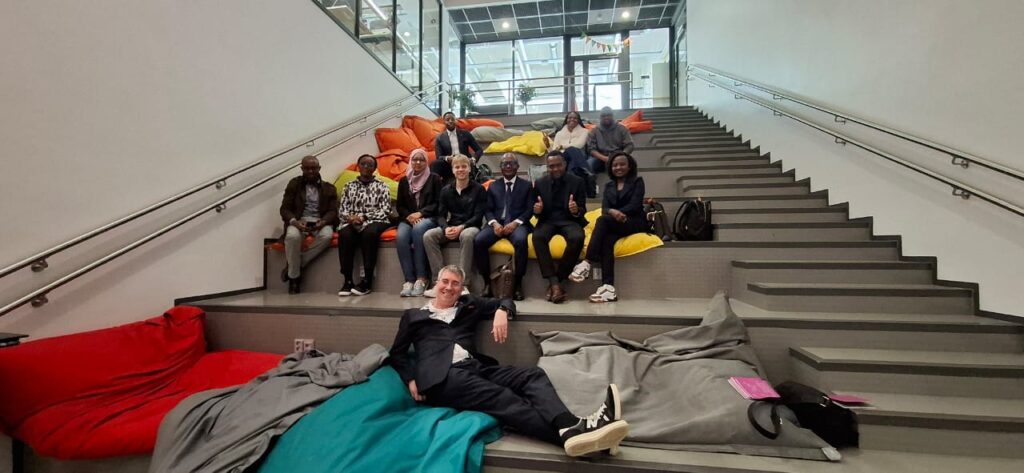
The visit was organized by Tanzania’s Information and Communication Technologies Commission (ICTC) together with the EU-funded Digital4Tanzania (D4T) Twinning Project, which brings Finland, as the leader of the project, Estonia and Germany together to support Tanzania’s digital transformation through institutional capacity-building, policy development and technical cooperation. The delegation, led by ICTC’s Head of ICT Development, Dr Ally Yahaya Simba, and including colleagues Fathiya Aboud Jumbe, Martha Heriely Maro, Innocent Elias Shayo, Jacob Mogesi Mosenda, Janeth Jackson Bagera, Venither Japhece Aligawesa and Lazaro John Msambazi, attended every one of the fourteen sessions on the programme, spanning ICT policy, cybersecurity, innovation, gaming, artificial intelligence, food security, startups, quantum computing, research and diversity in technology.
As the Twinning Project’s Resident Twinning Adviser, Jani Ruuskanen put it to Tanzania’s The Citizen newspaper, which followed the delegation throughout the week: “Digital transformation does not happen through policy alone. It has to be implemented from the bottom up.” The point of the week, he said elsewhere, was never to import Finland’s model wholesale, “but to build practical capacity that fits the Tanzanian context.”
Monday: Governance that Keeps Up with Technology, and A City that Sells Itself
The week opened at Demos Helsinki, an independent think tank that has spent two decades working on how governments make decisions about fast-moving technology without falling behind it. The delegation heard about the “Framework for Democratic AI Governance” the organization developed under its EU-funded KT4D project, and about a risk-assessment tool it built for Finland’s own Prime Minister’s Office, a scored checklist running from design through deployment that flags AI use cases as safe, worth reconsidering, or simply not to be used. It is the kind of instrument Tanzania does not yet have, and one of the more concrete, exportable ideas of the week.
In the afternoon, the delegation moved to Business Helsinki, the city’s own investment and talent-attraction arm, to see the other side of digital transformation: how a capital city actively competes for the people and companies who build these technologies. The Citizen’s coverage of the week’s broader lessons captured the underlying theme well. “We have gone through the whole ecosystem of innovation and AI,” Dr Simba told the paper. “We have looked at policies, innovation, research, startups and businesses. We have learned something from every part of that ecosystem.” He returned repeatedly to one point: “In every presentation, you see numbers. Those numbers are evidence of what has happened. Data is very important.”
Tuesday: Where Startups Actually Start
Day two took the delegation to Maria01, Europe’s leading startup campus, housed in the converted Helsinki hospital that has become, by its own numbers, home to some 180 startups and over €1 billion in cumulative funding raised by its members and alumni since 2016, and to Startup Sauna, Aalto University’s student-led entrepreneurship hub, before finishing at CSC – IT Center for Science, the state enterprise that runs Finland’s national supercomputing infrastructure, including the EuroHPC-funded LUMI supercomputer and its newly operational LUMI AI Factory.
What struck the delegation, according to Janeth Jackson Bagera, one of the Tanzanian startup founders on the trip, was how little of it depended on formal structures at the start. “Maria 01 and Startup Sauna in Finland started with people,” she told The Citizen. “Sometimes you can start with two people, a desk and Wi-Fi, and it can grow into something much bigger.” Moreover, Jani Ruuskanen made a related point about Maria01’s governance: it isn’t owned by a single ministry, fund or donor programme, but is a joint structure between the City of Helsinki, an enterprise agency and a foundation, a model that may travel better than one built around a single funder.
Dr Simba used the session to outline Tanzania’s current position: nationwide high-speed internet coverage stands at 94%, 5G coverage at 35%, and the National ICT Broadband Backbone extends 15,167 kilometers to 122 of the country’s 139 district headquarters. The National AI Strategic Framework for 2026–2031 is awaiting approval, together with a proposed National AI Readiness and Compute Demand Assessment Programme. “These investments provide a foundation for digital services and AI adoption,” he said, while acknowledging gaps in “specialized skills, data readiness, computing infrastructure, research and development, investment and institutional coordination.”
Wednesday: Gaming World, Quantum Bits, and Satellites Over Farms
Wednesday’s programme was the week’s most eclectic: the International Game Developers Association (IGDA) Finland, InstituteQ, Finland’s national quantum institute, a joint venture of eight universities and research organizations coordinating the country’s 2025–2035 Quantum Technology Strategy, and the Finnish Food Authority.
At IGDA, gaming expert Christopher Hamilton made the case that Finland’s gaming industry, which now generates an estimated €3 billion a year and produced Rovio (Angry Birds) and Supercell (Clash of Clans), grew out of the amateur “demo scene” of the 1990s rather than a government programme. His advice to Tanzania was to look at what already exists before building anything new: “When I think about if I were to create a game developer community now, it’s very important to understand: do you need the community?” He also saw an opening the delegation had not necessarily expected: international appetite for African stories. “As a consumer, as an international person, I want to hear and see more things from Africa,” he said, noting that Kiswahili could give Tanzanian studios reach across East Africa that few competitors can match.
The Finnish Food Authority presentation was, in its own way, the week’s most concrete demonstration of AI in daily government operation. Finland now verifies EU farm-subsidy eligibility across roughly one million land parcels using Sentinel satellite imagery, radar data and a deep-learning system called AIMO, cross-checked against farmer-submitted geotagged photographs through a companion AI tool. Presenter Åke Möller described a pipeline that runs almost entirely without manual inspection unless the automated system itself flags uncertainty. For a country where agriculture contributes close to a quarter of GDP and employs nearly two-thirds of the workforce, according to figures cited from Tanzania’s 2026/27 budget speech, the relevance was not lost on the delegation, nor was it lost on Ruuskanen, who was careful to frame the lesson correctly: the goal, he said, “is not simply to copy Finland, but to understand how technology, institutions and innovation can work together.”
Thursday: Defending Systems, Mapping the Country, and Sharing the Code
Thursday paired Finland’s National Cyber Security Centre (NCSC-FI), which handles roughly 19,000 information-security incidents a year and publishes a free national self-assessment tool called Kybermittari, with the Location Innovation Hub and the Centre for Open Systems and Solutions (COSS).
At the Location Innovation Hub, network coordinator Frank Nyamahowa made perhaps the most quotable case of the week for open data as public infrastructure, describing how Finland’s National Land Survey made its geospatial data freely available and let businesses build services on top of it rather than licensing access. “What would it be if Tanzania had this kind of infrastructure, if the entire country was digitally mapped and made available for anyone to use?” He asked the delegation, while cautioning, in the same breath, against simply copying what he’d shown them: “You can’t copy-paste. It doesn’t work.” He pointed to Tanzania’s own World Bank-backed Digital Tanzania Project, which is expanding digital mapping and street addressing from an initial 66 wards to 711 wards across 37 councils, as evidence that the groundwork is already being laid.
COSS added a related thread: Finland’s public sector has, since 2009, formally recommended open-source software for government systems, and its interoperability layer X-Road, jointly built and owned with Estonia, has been open-source since 2016. The lesson for Tanzania’s ICT Commission was less about any single tool than about the governance habit: publishing what the public has already paid for.
Friday: Ethics, the Blue Economy, and Closing the Gender Gap
The final day brought the delegation to VTT Technical Research Centre of Finland for a session on the ethics of AI development, then to LUKE, the Natural Resources Institute Finland, and finally to Mimmit Koodaa, the women-in-tech programme that closed out the week.
At LUKE, innovation specialist Janne Saarikko offered what may have been the week’s sharpest piece of practical advice, aimed squarely at researchers rather than policymakers: “Don’t innovate first. Before you start innovating, find someone who has a big enough problem.” He described a programme in which prospective founders are sent to interview 15 to 30 potential customers before writing a line of code. For a delegation working on Tanzania’s National Blue Economy Policy 2024 and its ten-year Fisheries and Aquaculture Blue Economy Action Plan, a sector the World Bank estimates supports 430,000 direct jobs and feeds 4.5 million more people through processing, marketing and trade, Saarikko’s caution about matching regulation speed to innovation speed landed directly on point.
Mimmit Koodaa, “Tech is for everybody,” in its own words, gave the week its most personal moment. Coordinator Milja Köpsi described starting the programme after being told, at fifteen, that IT classes were “for the boys,” and explained how a single workshop request from one self-taught woman grew into a community of more than 12,000, with over 1,000 women placed directly into technology jobs. Her pitch to the delegation was not about coding at all: “Every single company is nowadays a tech company. Is coding not for you? Okay, fine. But then it’s my responsibility to offer something else. Would you like to try UX design? Are you interested in data? For Janeth Jackson Bagera, the session reframed the opportunity in front of Tanzanian women in tech: “You can start there. You can do that today, like right now.”
What Comes Next?
Dr Simba’s closing assessment, delivered before the delegation’s return, is the fairest summary of the week: “Our foundation is already there.” We have an infrastructure. Now we need to put the missing pieces in place and scale up to the next stage.” The Twinning Project’s task over the coming months is to help turn that observation into a plan, matching what the delegation saw in Helsinki, Kluuvi, Espoo and Kajaani against what Tanzania’s own institutions, from the ICT Commission to its universities and startup hubs, can realistically build next.
The Digital4Tanzania (D4T) Twinning Project (REF: TZ 21 NDICI TE 01 22) is implemented by Finland, Estonia, and Germany with EU funding to support Tanzania’s digital transformation.