Cape Town Digital Twin Secondment in Pictures
Prologue
Official project photos have a habit of looking rather similar. People in suits, people around tables, people shaking hands in front of banners. They certainly have their place, but they rarely capture the richness and multi-dimensionality of the actual experience.
So instead of another conventional blog of the City of Cape Town Facilities Management Digital Twin secondment, I wanted to share something more human and memorable, via pictures: the people, places, conversations, odd moments and everyday experiences that made up the journey.
Indeed, a recurring theme of the secondment is that behind all the talk of leadership, Digital Twins, BIM, GIS, data, innovation and digital transformation, it is ultimately about people.
Here is my secondment journey in 26 pictures.
1 The Mother City, from a less polished angle
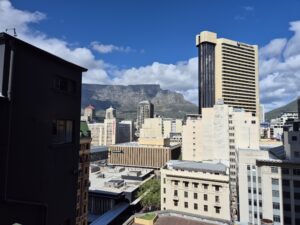
Cape Town, also known as the Mother City, can look surprisingly different depending on where you stand, both spatially and metaphorically. This is a slightly less manicured view across the rooftops of the city centre, with the ever-present Table Mountain in the background.
Perhaps a fitting place to start. Cities, like organisations, look very different once you move beyond the postcard view.
2 Where much of the story happened
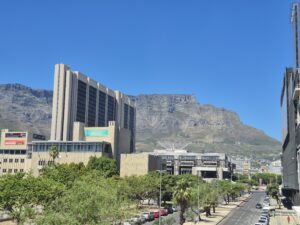
Cape Town Civic Centre, headquarters of the City of Cape Town, the metropolitan municipality governing this remarkable city.
Thousands of municipal employees work here, alongside the offices of the City’s political and administrative leadership. For several months, this became one of my workplaces too.
3 Day One
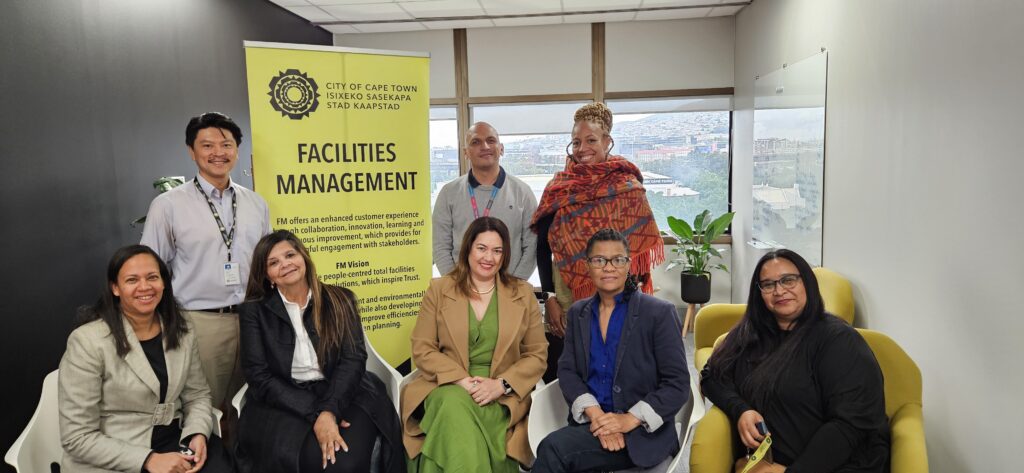
Day one of the secondment, meeting some of the key people who made the whole journey possible.
At this point, I had very little idea where the project would eventually lead. What followed were countless interviews, site visits, workshops, demonstrations, car conversations, coffees, unexpected introductions and plenty of detours. Many of the people in this first photo would remain closely involved throughout.
Back row from left: Vincent Kuo (me), Lindsay Wicomb (Systems and Technology), Tola Okunlola-Browning (Technical Partnerships). Front row from left: Lynn Spieringshoek-Martins (Infrastructure and Planning), Colleen Knowles (Communication), Janine Dookoo (Research and Development), Ronel Meyer (Integrated Facilities Management), Wafiqah Boolay (Facilities Management Interaction Centre).
4 A small badge with big meaning
 My City of Cape Town access badge is objectively just a piece of plastic that opens doors. Subjectively, it meant rather more to me. Wearing it every day gave me a small but genuine sense of belonging, and rather quickly I stopped feeling quite so much like a visiting expert and increasingly like part of the City family. I was very proud to wear it.
5 Sometimes nothing beats pen and paper
For all the talk about digitalisation, I discovered that sometimes nothing beats a pen and a notebook.
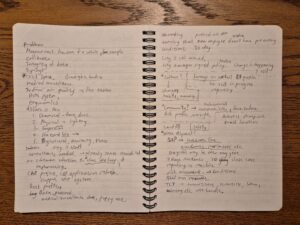
Much of the first phase was spent meeting, conversing, and listening through interviews, site visits, and informal discussions that rarely followed a neat script.
My notes became increasingly crowded with arrows, names, questions, contradictions and thoughts scribbled in the margins
This rather unstructured method enabled an ethnographic way of working, which turned out to be essential. The challenge was not simply to document what people told me, but to read between the lines and understand how things really worked, where the frustrations were, what motivated people, and the myriad relationships and incentives shaping the operational environment.
A Digital Twin may eventually be built from data, but understanding the organisation behind it still starts and ends with people.
6 Never underestimate the power of chocolate
Why is there a picture of a bag of chocolates in a Digital Twin project? Because sugar gets people talking.
 I decided to bring chocolates to interviews and workshops, and it somehow became one of the quirky little rituals of the secondment. As a parallel, one City colleague told me, quite seriously, that “you’d be surprised how many favours you can get from your team with a can of Coke.”
It reminded me of the famous Finnish enthusiasm for free buckets, where otherwise perfectly rational people have been known to queue from dawn for the privilege of acquiring one.
Different countries, different cultures, yet we all remain humble vassals of human nature.
7 Where the Digital Twin became real
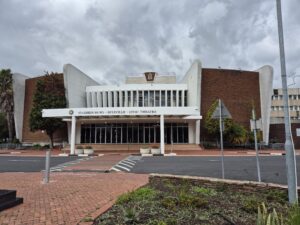
Bellville Civic Centre and the municipal offices attached to it became the main physical setting for our Digital Twin pilot work.
On paper, a building can look deceptively simple. Walk through it with the people who actually operate and maintain it, and suddenly it becomes a living network of offices, public spaces, banquette hall, theatre, plant rooms, equipment, maintenance histories, safety concerns, occupants and countless little operational details.
This was where many of the abstract ideas in the Digital Twin Framework started coming to life.
8 At the foot of the Bellville clock tower
A gathering outside Bellville Civic Centre, beside the clock tower and war memorial.
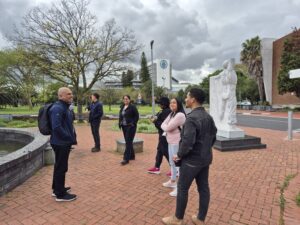 Site visits became an important part of the secondment because buildings are very difficult to understand from drawings and spreadsheets alone. Walking through spaces with the people responsible for them often revealed more in a few hours than days of studying documents could.
As was frequently the case, the useful conversations continued long after the walkthrough had supposedly ended.
People left to right: Lindsay Wicomb, Ryan Baatjes (Integrated Facility Management), Jenna Reisenberg (Priority Facility Management), Nompilo Khanyile (Project Manager), Sinead Pienaar (Architect), Reagan Campher (Architect).
9 Some of the most important meetings are not on the calendar
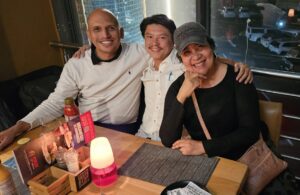
At Spur with Lindsay Wicomb (left) and Sharon Bock (right).
For anyone who grew up in South Africa, Spur needs little introduction. For everyone else, imagine a family restaurant that somehow found its way into the childhood memories of the whole country.
Lindsay and I drove to and from work together on most days during my visits. Those morning and evening journeys became some of the most valuable hours of the entire secondment. We talked about the project, of course, but also about people, organisations, leadership, adversity, careers and life. I savour these moments of mutual guidance, with a little informal therapy thrown in.
Sharon, meanwhile, was instrumental in bringing people together for many of the larger events, masterclasses and engagements. Her life stories and reflections also gave me plenty to think about regarding my own professional journey, and the much bigger question regarding digitalisation being a force for good.
None of these conversations had agendas, minutes or action lists. They were very important nonetheless.
10 Occasionally, there really was a podium
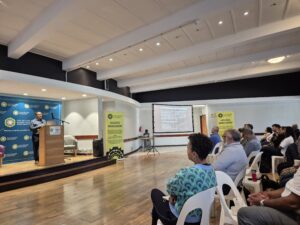
The Leadership Connect event, with Santesh Maharaj, Director of Facility Management Department, on leadership and teamwork. At the same event, I was given the chance to speak about Digital Twins, but also about Finland, South Africa and some of the early observations emerging from the secondment.
Standing in front of a large audience is obviously very different from sitting across a desk with one person and a notebook. Both are important. The smaller conversations helped me understand the organisation in depth, while events like this helped the ideas travel through it and created reach to a broader audience, whose feedback helped me discover viewpoints we hadn’t even considered.
11 Mandela and Tutu, watching over the Civic Centre
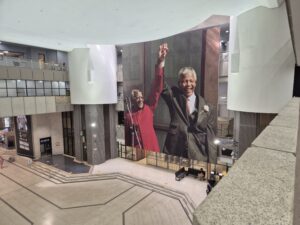 The Concourse floor inside Cape Town Civic Centre is dominated by this enormous three-storey mural of Nelson Mandela and Desmond Tutu.
It is difficult to work in South African public institutions without occasionally being reminded that the country’s present sits very close to an extraordinary recent history.
For me, it was also a useful reminder that digital transformation never happens in a vacuum. Institutions carry histories, cultures, inequalities, ambitions and memories with them.
12 Christmas in summer
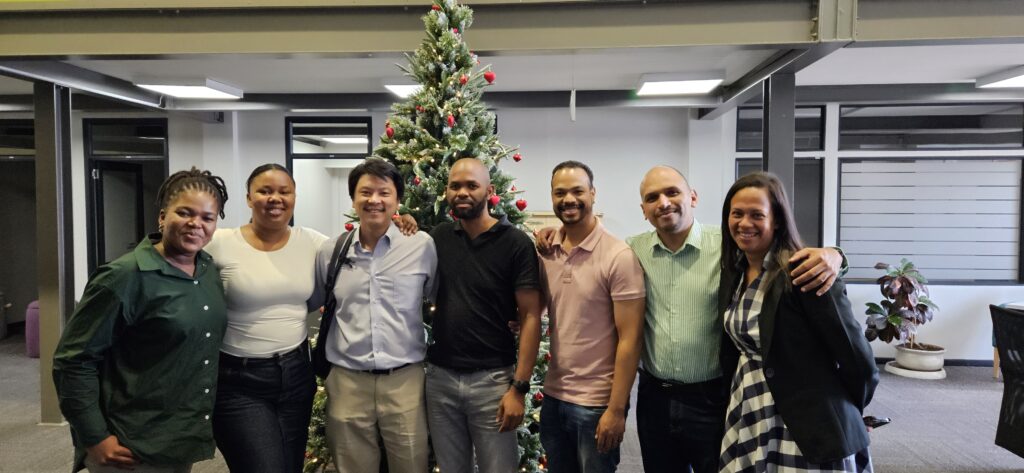 A December moment with colleagues at the Ficus Building in Parow, near Bellville.
For a Finn, Christmas decorations accompanied by warm sunshine undoubtedly feel slightly suspicious. In the South, the Christmas season is often spent on the beach.
This office and team became very close to my heart. I was based here during the latter half of the secondment, during which most of the technical Digital Twin developments occurred. By this point, arriving back in Cape Town increasingly felt less like starting another mission and more like returning to and catching up with colleagues I already knew.
People, left to right: Xola Xhegwana, Lethuthando Zulu, Vincent Kuo, Lwando Dlokolo, Brent Julie, Lindsay Wicomb, and Lynn Spieringshoek-Martins.
13 Making technical things understandable
A presentation from Reagan Campher (Architect) and Lynn Spieringshoek-Martins (Infrastructure and Planning Manager) on Digital Twins at the Master Class event, where I also delivered a talk on real-world examples of data analytics, artificial intelligence, and their practical impact.
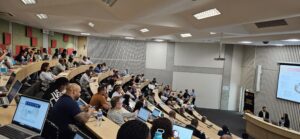 One challenge throughout the secondment was that the audience was rarely homogeneous. In the same room you might have engineers, administrators, managers, planners, facilities staff and people who had never heard the term “Digital Twin” before.
That diversity is one of the City’s strengths, but it also means that technical ideas have to survive translation into ordinary language. If an idea only makes sense to the specialists who created it, it will not travel very far.
14 Cape Town is not the whole of South Africa
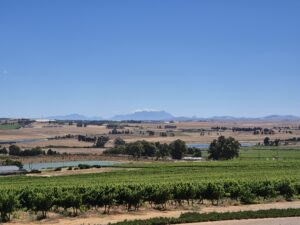
Looking toward Cape Town from “Agter Paarl”, behind Paarl Mountain in the Winelands.
Table Mountain is just visible in the distance, complete with a faint trace of its famous tablecloth.
Cape Town is spectacular enough that it can sometimes behave as though the rest of the country exists mainly as scenery beyond the city limits. However, much of South Africa’s land, agriculture, infrastructure and economic life lies far beyond the metropolitan boundary. It was a useful reminder that the problems we were exploring in one municipal organisation sit within a much larger and very diverse national context.
15 A different kind of site visit
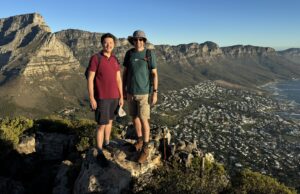
At the summit of Lion’s Head with Johan Gerber (Maintenance Planning), looking across toward Table Mountain, the so-called Twelve Apostles and the Atlantic seaboard. One would not have guessed by such blue skies and calm seas that there had been intense storms all around the Cape just a few days prior.
Johan was one of the people closely involved in the Cities Infrastructure Delivery Management System (CIDMS) that became increasingly important during the secondment as a fundamental component for Digital Twin’s asset data layer. I’m grateful for his conversations and company, amid climbing and seeing some of the finest possible perspectives on the city. Sometimes changing the viewpoint literally also helps to develop new approaches to problem solving.
16 Never underestimate Excel
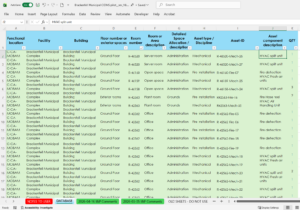
No matter where you go in the world, and whether you love Microsoft or not, it is difficult to ignore Excel’s contribution to democratising data analysis.
A huge amount of Facility Management information still lives in spreadsheets: asset registers, room lists, condition data, maintenance information and countless other operational records. They may not look futuristic, but these humble tables are often where Digital Twins actually begin.
Before connecting data to sophisticated 3D models, dashboards or AI, you first have to understand what you already have.
17 Real-world data is messy, because humans are messy
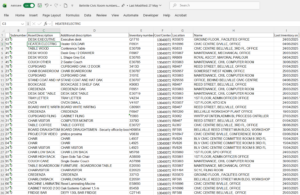 The movable asset register is an important component of the Facility Management Digital Twin and offers a wonderful example of real-world data. Something as seemingly straightforward as a location and a piece of furniture, such as a chair, can be described in many different ways depending on who entered the data, when they did it and what terminology they happened to use.
This is one reason I became interested in natural language processing (NLP) 15 years ago. Human-created data is wonderfully inconsistent in terms of semantic differences, abbreviations, spelling variations, competing classifications and descriptions that make perfect sense to one person but not necessarily to a computer.
The irony is that some of the hardest problems in digitalisation are created by exactly what makes us human.
18 So, what exactly is BIM?
Here we finally meet the 3D building model. 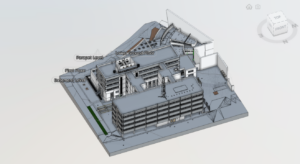
BIM, or Building Information Modelling, is much more than a pretty three-dimensional picture. The model can represent walls, doors, floors, mechanical and electrical assets, equipment and other building components together with information describing those objects, as well as their functional or spatial relationships to one another.
In other words, the geometry and the data can begin to live together in BIM.
19 Peeling the building apart
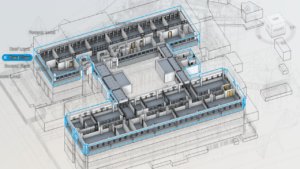 A closer view of the Bellville BIM model, third floor.
One of the useful things about a digital model is that you can zoom in, filter, hide parts of the building, slice through floors and inspect individual components in ways that would be rather inconvenient with the real building.
Click on an object and you may be able to find out what it is, what it is made of, where it sits and what other information has been attached to it.
The building starts becoming something you can query rather than simply look at.
20 When an air conditioner becomes more than an air conditioner
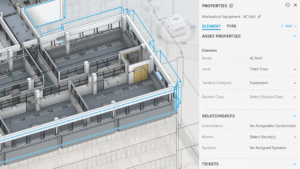
Here, an air-conditioning unit in the Bellville model has additional asset information attached to it.
That information might include an asset ID, installation date, manufacturer, condition, maintenance history or current operational status. If live sensors are available, changing measurements such as temperature, pressure or equipment performance could also be linked over time. Moreover, all these data help to create reasoning capabilities for diagnostics and routine- and predictive maintenance planning.
This is where the idea of a Digital Twin becomes particularly useful for Facilities Management. An object you see in the model can become an entry point to the operational story behind the physical asset and other related assets in real-world building operations.
21 Walking through a building without walking through it
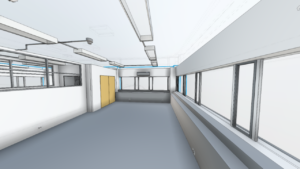 The BIM environment can also provide first-person views, allowing users to move through the digital building almost as if they were walking inside it.
This may sound merely cosmetic, but it can be surprisingly useful for communication. Not everybody thinks naturally in plans, technical drawings or engineering models.
Sometimes the easiest way to explain where something is located or how a space feels is simply to say: “Come, let me show you.”
A digital building can do something similar. Naturally, there are countless specific applications beyond operations and repair, such as renovations, fire compliance, occupational health and safety exercises, occupant well-being analyses, etc.
22 And now, some blinking lights
A lightweight IoT (internet of things) mock-up showing room temperatures, occupancy and asset information spatially on the floor plan of Bellville Office’s Third Floor, South Block.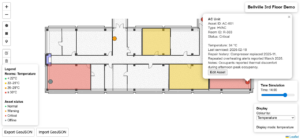
This was deliberately simple. A Digital Twin does not always need an expensive 3D interface to communicate something useful. A two-dimensional heat map can already show which rooms are unusually warm, heavily occupied or affected by an equipment problem.
We also explored how this kind of facility-level information could connect with the City’s broader GIS environment through collaboration with the Geomatics team.
The bigger lesson was not that every dataset belongs in one magical platform. Quite the opposite. BIM, GIS, dashboards, sensors and enterprise systems each have different strengths. The useful Digital Twin emerges when those pieces can talk to each other, and at a reasonable cost.
23 A serious project does not require serious faces
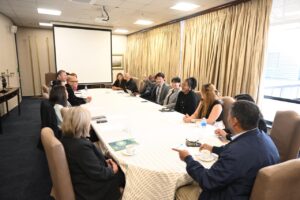 One thing you quickly notice when spending time with South Africans is the sheer amount of laughter.
Meetings, workshops, corridors, coffee breaks, even fairly serious discussions somehow seem to contain an unusual amount of it. To outsiders this might occasionally appear strange. I have come to regard it as something of a South African superpower.
There is certainly no shortage of problems to frown about. Perhaps that is precisely why remembering to laugh is very important. Digital transformation is difficult enough with a positive mindset, let alone a negative one.
24 Celebrating a partnership, not just a project
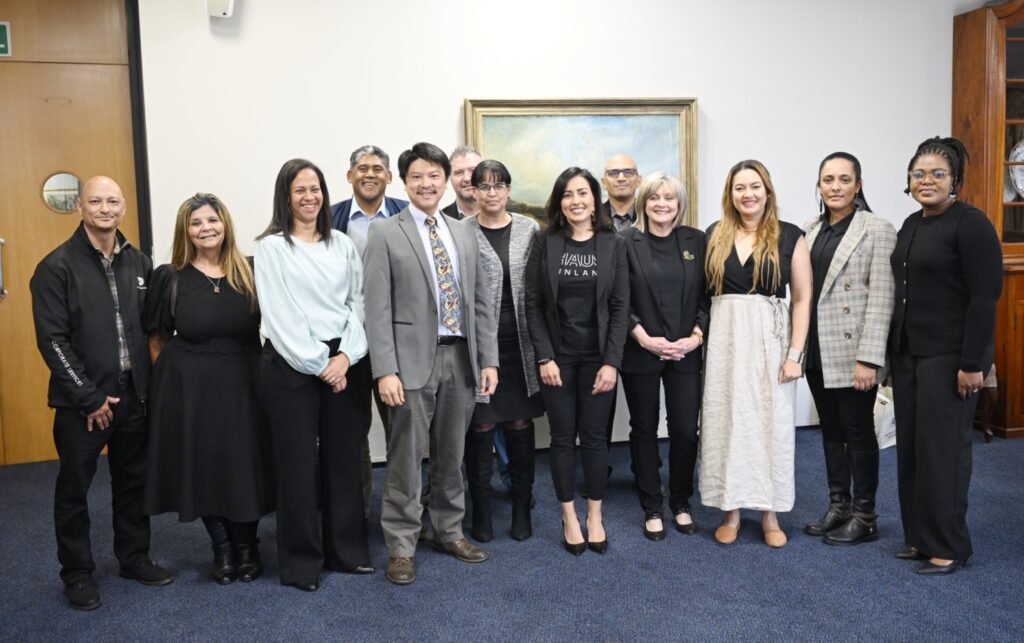
Our closing partnership event brought together colleagues from the City of Cape Town, HAUS and the wider secondment journey.
Speeches ranged across technology, Digital Twins, smart cities, teamwork, diversity, Finland, South Africa and the possibilities that might come next. What struck me most was not any particular narrative, but the genuine energy and enthusiasm in the room.
By this point, the secondment no longer felt like an isolated assignment with a start date and an end date. It felt much more like the beginning of relationships that could lead somewhere else.
Where exactly that might be is still to be written.
25 The institutions have people behind them
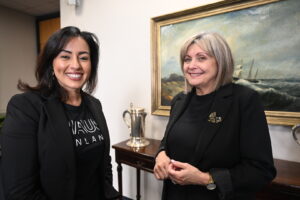
People representing the two sides of the partnership: HAUS Finland and the City of Cape Town.
On the Finnish side, Shirin Namiq (left) joined us from Pretoria, where she supports HAUS activities in the region. On the Cape Town side, Theresa Uys (right), Alderman from the City’s political leadership, brought another important perspective to the discussion around digitalisation, citizen value, and future cooperation.
Projects like this are often described through institutional names, programmes and acronyms. However, it is people rather than institutions that actually collaborate with one another. Indeed, the project was made possible because some people took the initial steps and made the first phone calls.
26 Never skip the greeting
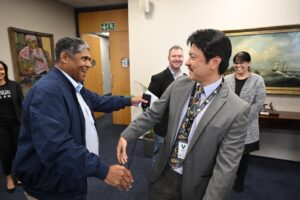 Greeting between Ernest Sass (left), Executive Director of Corporate Services of the City of Cape Town, and myself (right). Ernest had been instrumental in creating the relationships and providing the approvals that realized the secondment, which he has supported with unwavering passion, energy, and humour.
If there is one South African habit that I would happily export to Finland, it might be the greeting. A handshake, a hug, a quick conversation about your family, your weekend, the traffic, new shoes, somebody’s peculiar brother-in-law, or whatever else happens to arise before anybody gets down to business.
Taken individually, these moments seem trivial, but added together over months, they become the backbone of genuine relationships. I sometimes joked that we could spend three hours a day greeting colleagues. That is probably not a productivity metric I would recommend putting into a project indicator, but I am increasingly convinced that it accomplished things that another three hours of meetings never could.
Epilogue
Leaving Cape Town at the end of the secondment turned out to be more emotionally difficult than I had expected.
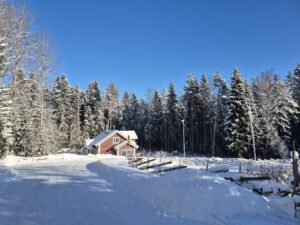 On the one hand, I had been missing my home by the Finnish forest, but returning also meant saying goodbye to some of the kindest, most generous and inspiring people I have had the pleasure of working with.
I feel enormously fortunate to have been part of this Digital Twin journey. Professionally, it allowed me to combine many of the things I care about: cities, buildings, data, artificial intelligence, digitalisation and the messy realities of making technology useful. Personally, it allowed me to connect two countries that I am fortunate enough to call home.
Most of all, it gave me the privilege of working alongside an extraordinary range of people within City of Cape Town Facilities Management, from young colleagues in the Expanded Public Works Programme all the way to the colourful senior management and the Executive Director.
From the Finnish side, this was also one of the first FDGT secondments to reach completion. That made the experience something of a learning journey for all of us, including HAUS. I hope that some of the lessons, experiments, and successes from Cape Town can help shape future secondments and other forms of co-creative cooperation, whether with the City, elsewhere in South Africa, or further afield.
To my Cape Town colleagues, I hope the experience left you with something worth sharing, something beyond the Digital Twin Framework or a collection of technical ideas or demos, but also an increased sense of confidence about what might be possible and how you might get there.
We in Finland certainly came away inspired by the City’s ambition, perseverance and extraordinary diversity of people and capabilities. I hope this first chapter creates opportunities for much more concrete cooperation between South Africa and Finland in the years ahead.
And if someone asks whether I would participate? You probably already know the answer.
Thank you to everyone who made the journey possible!
